How Many Copies to Print for Your First Book?
How Many Copies to Print for Your First Book?
This is the single most expensive decision you will make as a self-published author.
Get it right and your book pays for itself, you can hand a copy to anyone who asks, and you have stock ready when an unexpected order comes in. Get it wrong in either direction and you either spend years apologising for being out of stock, or you spend years stepping over boxes of unsold books in your living room.
We've worked with hundreds of first-time authors at VST Press, and the same pattern repeats. Most authors guess too high — usually because the per-copy price drops so dramatically at higher quantities that ordering more feels like saving money. It is not. This guide is the conversation we have with authors who ask us this question before sending an order.
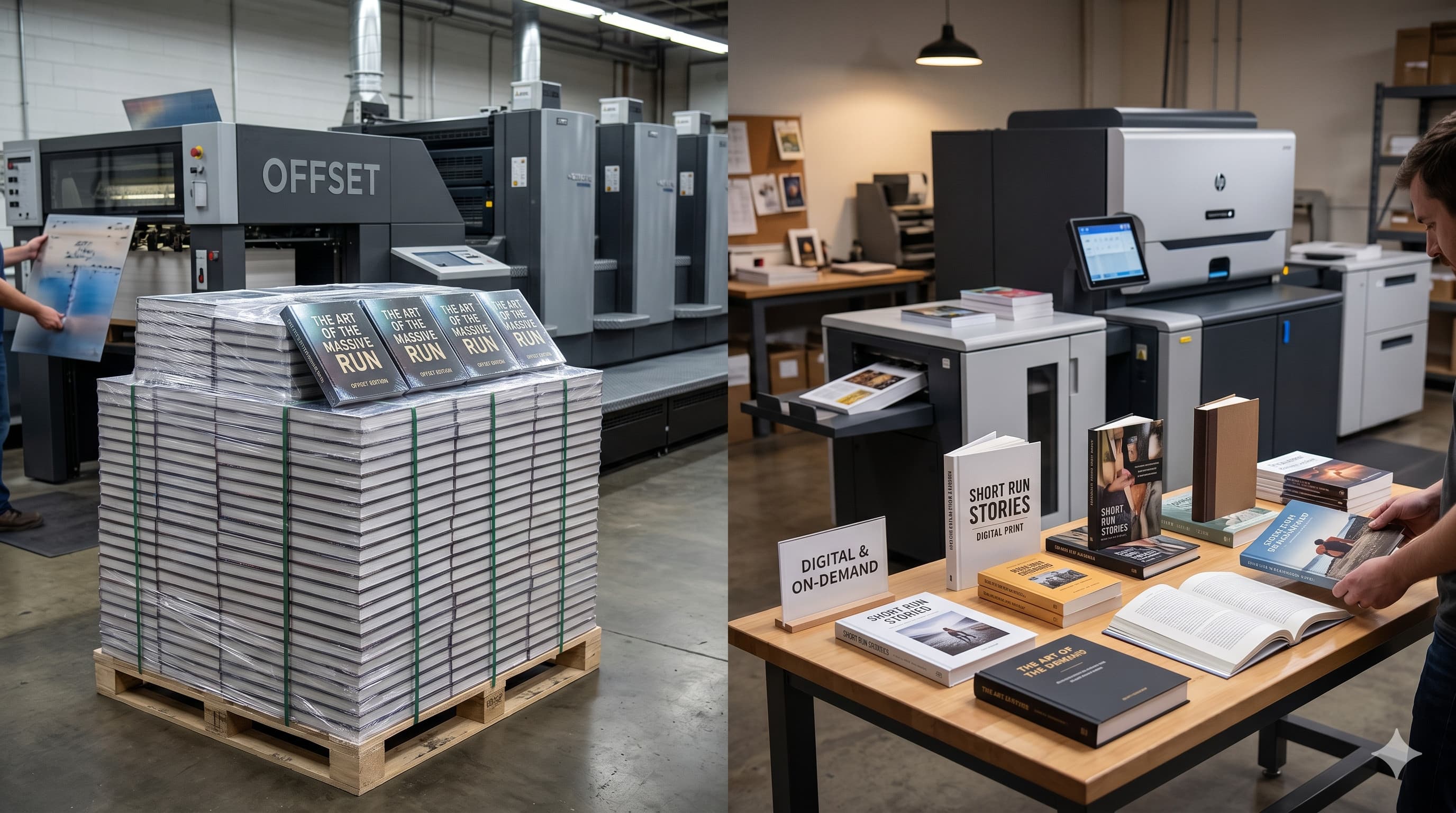
Before you read on: the quantity decision and the printing method decision are linked but separate. Once you have a quantity in mind, our guide on Offset vs digital printing — which method is right for your book? walks through how the method choice follows from the number.
The Trap: Confusing "Cheaper Per Copy" with "Cheaper Overall"
Here is the math that fools every first-time author.
Imagine you ask us to quote a 200-page paperback. The numbers might look like this:
| Quantity | Per copy | Total spend |
|---|---|---|
| 100 copies | ₹110 | ₹11,000 |
| 500 copies | ₹80 | ₹40,000 |
| 1,000 copies | ₹60 | ₹60,000 |
Looking at the per-copy column, 1,000 copies looks like a bargain — almost half the price of 100. But you're not comparing 100 copies to 1,000 copies. You're comparing ₹11,000 to ₹60,000. That is more than five times the cash out the door for a book whose actual demand you have not yet proven.
The right question is never "what is the cheapest per-copy price?" It is "what is the smallest order that meets my real, demonstrated needs for the next 6 to 12 months?"
Step 1: Be Honest About Who Will Read Your Book
Most authors imagine selling to "readers" — a vague mass of strangers who will discover the book and buy it. In reality, your first 100 to 200 sales come from people you know or people one degree away from you. Strangers come later, slower, and only if the early circle does the work for you.
Sit down and write actual numbers in four buckets:
-
People who will buy because they know you. Family, close friends, colleagues, your immediate professional network. Be honest — not everyone will buy, even if they say they will. A realistic conversion is 30 to 40 percent of the people you would personally invite to a book launch.
-
People in your wider network who are reachable. Your social media followers, mailing list, WhatsApp groups, alumni networks. Out of every 100 of these contacts, you might convert 1 to 3 percent into actual buyers without major effort. With sustained promotion, maybe 5 to 8 percent.
-
People who get a free copy. Reviewers, podcasters, bloggers, journalists, librarians, influencers in your topic area. These are not sales but they are copies that leave your hands. Plan for 15 to 30 of these for a first launch.
-
Cold readers — actual strangers. People who find the book on Amazon, in a bookstore, through a recommendation. For a first-time self-published author with no marketing budget and no platform, plan for nearly zero of these in the first six months. The exceptions are authors with strong existing audiences (an active YouTube channel, a popular blog, a public profile in their field).
Add the four buckets together. That is your honest first-year demand estimate. For most first-time authors, the number lands somewhere between 75 and 250 copies.
Step 2: Match Quantity to How You Plan to Sell
The number of copies you actually need depends almost entirely on your distribution plan. Different channels need different volumes.
Direct sales (events, friends, your website): This is how most first-time Indian authors actually move books. You sell from a table at a launch event, ship via India Post or Delhivery to people who message you, and sign copies in person. Inventory needed: roughly equal to your honest demand estimate plus 25 percent buffer. For most first-timers, 75 – 200 copies.
Bookstore consignment: Independent bookstores in India will sometimes take 5 to 20 copies of a self-published title on consignment. They pay you only when copies sell. If you plan to approach 5 to 10 bookstores, plan for 50 to 150 copies dedicated to consignment alone — and accept that some will come back unsold.
Amazon and online marketplaces: If you list on Amazon India and fulfil yourself, you'll need stock on hand for orders. If you use Amazon's print-on-demand or KDP, you don't print at all — Amazon prints individual copies as orders come in. Many Indian authors run a hybrid: a printed run for direct sales and KDP for global Amazon orders. KDP's per-copy cost is higher than your local printer, but you carry no inventory risk for online orders.
Bulk channels (corporates, schools, libraries): If you have a confirmed bulk order — say, a school has agreed to buy 100 copies for its library, or a company has ordered 50 copies as gifts — print exactly that quantity plus your other demand. Do not pre-print speculative bulk inventory unless the order is in writing.
Step 3: Do the Storage and Shipping Reality Check
A box of 50 paperbacks weighs roughly 15 to 20 kilograms and takes up about the same space as a microwave oven. A thousand copies is twenty boxes. That is a wall of cartons in a spare room or under your bed for the next eighteen months.
If you live in a Chennai or Bengaluru flat, this is not a small problem. Stock that sits in humid Indian conditions for too long develops a musty smell, the covers warp, and the paper yellows at the edges. A book that sat in a box for three years is not the same book you printed.
Shipping is the other tax. Sending a single book by India Post costs ₹40 to ₹80, by courier closer to ₹100 to ₹150. Multiply by every order you fulfil yourself. If you plan to ship 200 books in your first year, that is ₹15,000 to ₹30,000 in shipping you may not have budgeted.
A smaller print run is not just cheaper to print — it is cheaper to store, easier to manage, and lower-risk if your book turns out to need cover changes or interior corrections in version two.
Step 4: Run the Financial Math
Before placing the order, run three scenarios on paper. We strongly suggest using realistic numbers, not optimistic ones.
| Scenario | Copies sold in year 1 | Revenue (at ₹350 cover price) | Print cost (1,000 copies @ ₹95) | Profit / Loss |
|---|---|---|---|---|
| Optimistic | 600 | ₹2,10,000 | ₹95,000 | + ₹1,15,000 |
| Realistic | 200 | ₹70,000 | ₹95,000 | – ₹25,000 |
| Conservative | 80 | ₹28,000 | ₹95,000 | – ₹67,000 |
Now run the same scenarios with a 100-copy print run at ₹220 each (₹22,000 total):
| Scenario | Copies sold in year 1 | Revenue (at ₹350 cover price) | Print cost (100 copies @ ₹220) | Profit / Loss |
|---|---|---|---|---|
| Optimistic | 100 (sold out) | ₹35,000 | ₹22,000 | + ₹13,000 |
| Realistic | 80 | ₹28,000 | ₹22,000 | + ₹6,000 |
| Conservative | 50 | ₹17,500 | ₹22,000 | – ₹4,500 |
Notice the asymmetry. Smaller print runs lose less if the book underperforms and break even more easily if it does modestly well. They also leave you free to reprint when you need more — which is the strategy that actually wins.
Step 5: Plan to Reorder, Not to Stockpile
This is the single most important shift in mindset for a first-time author.
Modern digital printing has made the case for huge first runs much weaker than it was twenty years ago. A digital reprint of 50 or 100 copies takes us 3 to 5 days and costs the same per copy as the original order. Selling out is not a failure — it is a signal that lets you reorder with confidence.
The smart pattern most successful first-time authors follow:
- First run: A small digital run sized to honest demand — usually 75 to 200 copies.
- Promote and observe: Track how the book moves over the first three months. Is it selling steadily? Slowly? Picking up?
- Reorder small if demand is uncertain: Another 100 or 200 digital copies if needed.
- Switch to offset only when sure: If the book is genuinely selling and you can confidently order 500 to 1,000 copies, an offset reprint will give you a much better unit price for the longer run.
This is the "test small, scale into demand" pattern, and it is the single biggest behavioural change we recommend to first-time authors.
For more on when to switch from digital to offset, read our companion guide on offset vs digital printing for books.
A Simple Decision Framework
If you remember nothing else from this article, remember these five questions:
- How many copies can I realistically sell in the next six months? Be honest. Use the four-bucket method above.
- Where will the books go after I print them? Direct sales, bookstores, Amazon, bulk orders — get specific.
- How much physical space do I have for inventory? A thousand books need a wall of cartons.
- What is the maximum amount I am willing to lose if the book sells nothing? Treat the print cost as money at risk.
- Can I reprint quickly if I run out? With digital printing, yes. So running out is not a disaster — it is data.
Most first-time authors who walk through these honestly end up printing between 75 and 250 copies for their first run. Almost no one needs 1,000 copies for a first edition.
Common Mistakes We See
Mistake 1: Ordering 1,000 copies because the per-copy price is irresistible. The per-copy price means nothing if the books don't sell. Always look at total spend and worst-case loss.
Mistake 2: Counting friends and family as guaranteed buyers. They mean well. Many won't actually buy. Discount your network estimate by 50 to 60 percent for realism.
Mistake 3: Forgetting about giveaway copies. Reviewers, gifts, comp copies for contributors — these are real copies that leave your inventory without bringing in revenue. Budget for them.
Mistake 4: Treating the first print run as the only print run. It is not. Reprints are easy with digital printing. Plan to reorder.
Mistake 5: Letting cover price determine print run instead of the other way around. A higher cover price means you can afford a smaller print run more comfortably. Set price and quantity together, not separately.
Get a Quote and See Real Numbers
The best way to decide is to see actual quotes for several quantities at the same time. We routinely quote 100, 250, 500, and 1,000 copies in parallel so authors can see exactly how the numbers move at different scales.
Send us a quote request with your page count, trim size, and a quantity range — even a guess. We'll come back with side-by-side numbers and an honest recommendation for your situation.
Still working out the numbers? Email us at info@vstpress.com. We're happy to walk through the math for your specific book before you commit to anything.