Offset vs Digital Printing: Which Is Right for Your Book?
Offset vs Digital Printing: Which Is Right for Your Book?
Almost every author who calls us asks the same question.
"Should I print my book offset or digital?"
It sounds technical, but the choice shapes three things that matter a lot — what your book costs per copy, how long it takes to reach your hands, and how it feels when a reader holds it. Choose the right method and the economics work in your favour. Choose the wrong one and you either pay too much or wait too long.
At VST Press, we run both offset and digital presses every day. This guide is the same explanation we walk authors through when they visit our Chennai office — without the sales pitch.
Note: This post focuses on the method choice. The closely related question — how many copies should I print in the first place? — is covered separately in our guide on How many copies should I print for my first book?. Read that one first if you haven't decided on a quantity yet, because quantity is the single biggest factor in this decision.
The Short Answer
If you're printing fewer than around 300 copies, choose digital. If you're printing more than around 500, choose offset. Between 300 and 500, it depends on the book — colour content, paper choice, and turnaround all tip the balance.
That's the rule. Everything below explains why, and when to break it.
What Is Digital Printing?
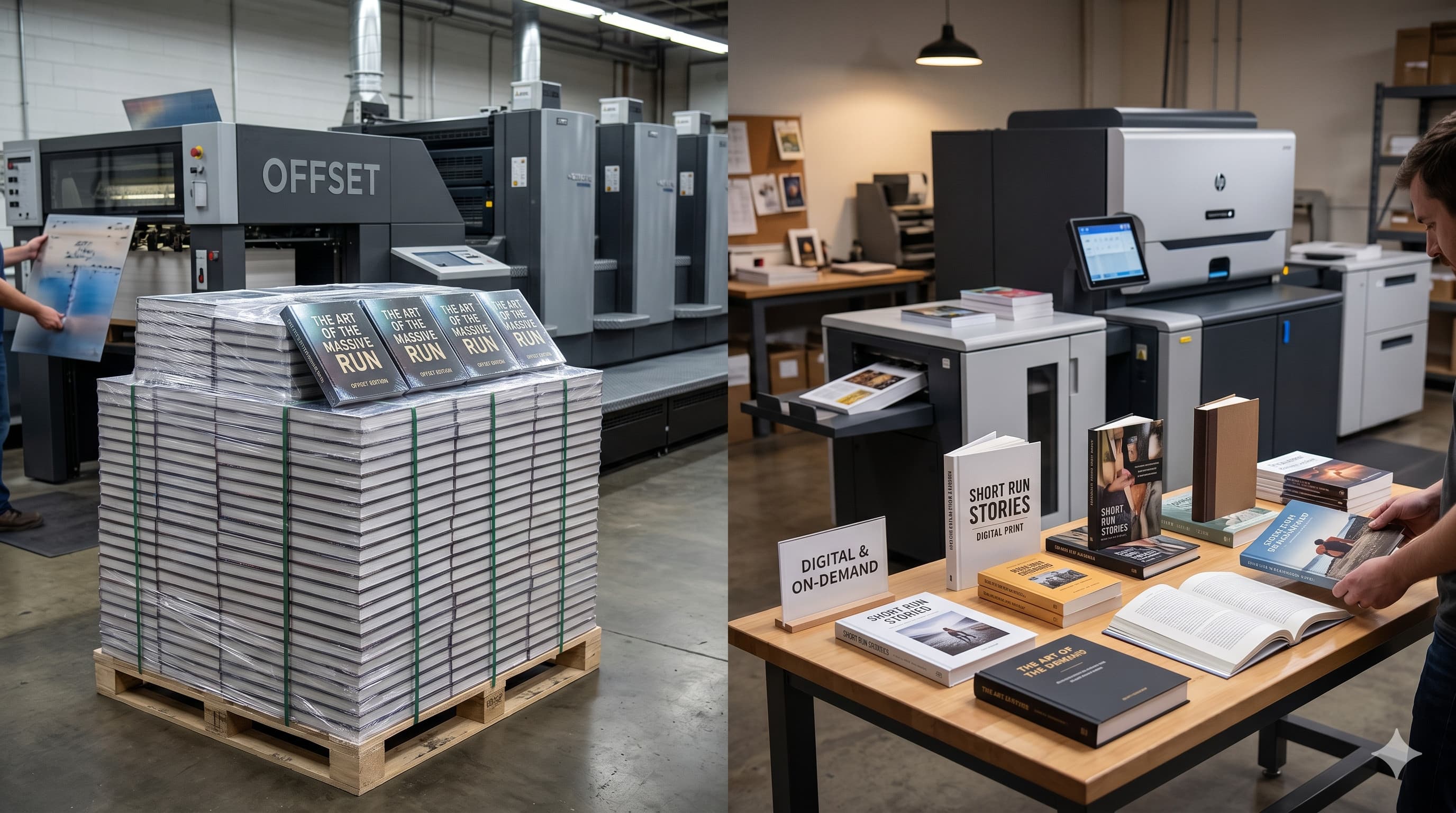
Digital printing works the way an office laser printer works — but on industrial scale. Your PDF goes directly from a computer to the press. No plates. No setup. The press lays down toner (or sometimes ink) sheet by sheet, page by page.
Because there is no setup, you can print one copy as easily as one hundred. The cost per copy stays roughly flat whether you order 30 books or 300.
Best for:
- Short runs (30 – 300 copies)
- First editions where you're testing the market
- Books that need fast turnaround
- Print-on-demand and small reorders
- Author copies, advance review copies, gifts
What Is Offset Printing?
Offset is the traditional printing process. Your file is burned onto metal plates — one plate per colour, per side. Those plates transfer ink onto a rubber blanket, which then "offsets" the ink onto large sheets of paper. The sheets are folded, gathered, sewn or glued, and trimmed into books.
Setting up an offset job takes time. Plates have to be made. Ink has to be mixed. The press has to be calibrated and test sheets checked. Once it's running, though, an offset press prints fast — thousands of impressions per hour — and the per-copy cost drops sharply with volume.
Best for:
- Long runs (500+ copies)
- Books going into bookstores or distribution
- Premium titles where colour fidelity matters
- Reprints of established titles
- Educational and academic books in volume
Side-by-Side: How They Actually Differ
| Factor | Digital Printing | Offset Printing |
|---|---|---|
| Setup cost | Almost none | Significant (plates, calibration, ink) |
| Per-copy cost | Flat — same for 30 or 300 | Drops as quantity rises |
| Minimum order | 30 copies | Typically 500+ for cost efficiency |
| Turnaround | 3 – 5 days | 10 – 20 days |
| Colour quality | Excellent for most books | Superior for fine art and photography |
| Paper options | Limited but covers most needs | Wide range, including specialty stocks |
| Reprint flexibility | Easy — just press print again | Plates can be reused, but setup repeats |
| Personalization | Possible (different name on each copy) | Not possible |
The Cost Curve: Where the Two Lines Cross
This is the part most authors don't understand until they see it on paper.
Digital printing has an almost flat per-copy cost. The 50th copy costs roughly the same as the 500th. Total spend rises proportionally — order twice as many books, pay roughly twice as much.
Offset printing has a steep cost curve. The first copy is expensive because you're paying for plates and setup before a single book exists. As quantity rises, that fixed setup cost spreads across more copies, and the per-copy price drops sharply.
Here is what those two cost curves actually look like, using our real prices for a typical book:
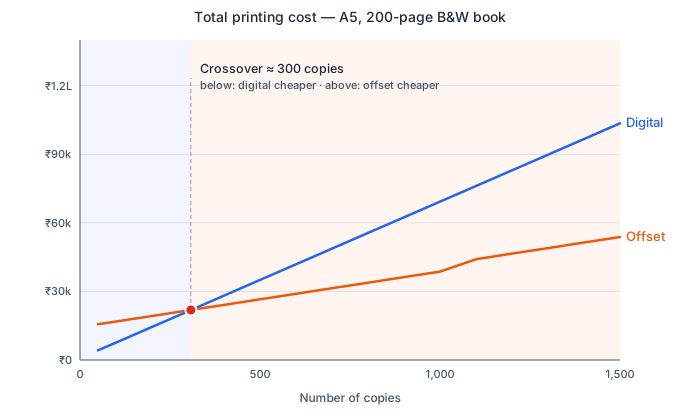
For a typical A5, 200-page black-and-white book on our presses, the two curves cross at around 300 copies. Below that, digital is meaningfully cheaper — at 100 copies, offset costs more than twice what digital does. Above 300, offset pulls ahead, and the gap widens fast — by 1,000 copies, offset costs roughly half what digital does.
The Per-Copy View
Looking at the same data as a per-copy price tells the second half of the story:
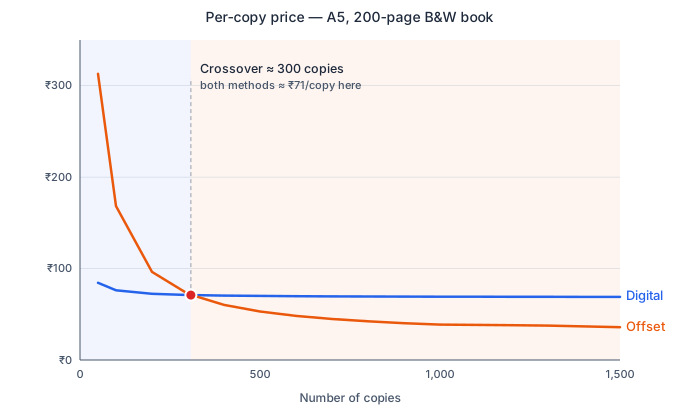
Digital pricing is essentially flat — around ₹70 per copy whether you order 50 books or 1,500. The setup cost is so small that quantity barely changes anything.
Offset is the opposite. The first 50 copies cost over ₹300 per copy because the press setup, plates, and ink mixing have to happen regardless of run length — and at small quantities, that fixed cost is divided across very few books. As quantity rises, that setup cost spreads thinner. By 1,000 copies offset is around ₹39 per copy, and by 1,500 copies it has fallen further to roughly ₹36 per copy — close to one-ninth of where it started.
This is the reason offset rewards committing to scale. It is also the reason small offset reorders sting: every reprint pays for setup all over again, and the per-copy price climbs back up.
The exact crossover depends on the book. Hardcover binding, larger trim sizes, and full-colour interiors push the crossover later — sometimes to 500 or even 800 copies — because offset's quality and paper advantages compound at higher volumes. But for the most common self-publishing job, the threshold sits right around 300.
When you ask us for a quote, we usually calculate for both methods and we will share pricing for the method that is cost-efficient.
Quality: Is Offset Really Better?
Yes — but probably not in the way you expect.
For 95% of self-published books — novels, memoirs, business books, poetry, most non-fiction — modern digital printing is indistinguishable from offset to the average reader. Black text on cream paper looks the same. Cover art prints sharp. Nobody picks up the book and says "ah, this was digitally printed."
Where offset still pulls ahead is in fine reproduction:
- Photography books and art books with subtle gradients and skin tones
- Books with large solid colour fields (offset gets perfectly even ink lay-down; digital can sometimes show banding)
- Books printed on uncoated, textured, or specialty papers — offset handles them better
- Books where Pantone (PMS) spot colours need to be matched exactly
If your book is mostly text with a colour cover, this rarely matters. If you're publishing a coffee-table book of photographs, it matters a lot.
Turnaround: How Fast Can You Get the Book?
Digital wins on speed, every time.
A standard paperback printed digitally goes from approved file to bound book in 3 to 5 working days at our press. We have delivered author copies in 48 hours when there is a launch deadline.
Offset takes longer because of setup. Plates have to be imaged. Ink has to be mixed and matched. The press has to be locked in. A typical offset job for a paperback novel takes 10 to 20 working days in our schedule, sometimes more during peak season.
If you're launching at an event, doing a book signing, or sending review copies to bloggers next week — digital is the only realistic option.
Paper, Binding, and Finishing
Both methods support most paper choices most authors care about — 70 GSM and 80 GSM cream paper for novels, 80 GSM white maplitho for non-fiction, 130 GSM art paper for colour books. Both can do paperback (perfect bound) and hardcover (case bound) finishing.
Where they differ:
- Specialty papers (handmade, metallic, textured, very heavy stocks above 350 GSM): generally only available offset
- Very thin papers (below 60 GSM, like Bible paper): offset handles them; some digital presses don't
- Foil stamping, embossing, spot UV on the cover: best only in offset for large runs
For a typical novel or non-fiction book at standard paper weights, both methods produce a book that feels and reads identically.
Reprint Economics: A Quiet Trap
Most first-time authors don't think about reprints. They should.
Offset rewards you for printing a lot at once but punishes you for reordering small quantities later. If you print 1,000 copies offset, then run out and need 100 more, that reorder will cost almost as much per copy as digital — because you're paying for setup again on a small run.
Digital is the opposite. Reprints are trivial. Need 50 more for a school visit? We'll have them in three days, at the same per-copy price as your original order.
This is why a sensible long-term strategy often combines both: digital for the first run while you learn what demand looks like, offset for the larger reprint once the book is proven.
When to Choose Digital — Even Above the Threshold
Sometimes digital is the right call even when offset would be cheaper per copy:
- You want personalised copies — different dedications, signatures, or names on each book
- You're testing different cover designs or interior layouts
- Your launch is in two weeks and offset can't deliver in time
- You're printing on stock paper sizes that the digital press handles natively
When to Choose Offset — Even Below the Threshold
A few cases tilt the decision toward offset earlier than the cost curve suggests:
- Your book has heavy colour content that needs photographic-grade reproduction
- You're printing on a specialty paper that digital presses can't run
- You need exact Pantone colour matching for branded covers
- You're producing for a publisher or distributor who specifies offset quality
A Decision Framework for the Method Choice
Once you've settled on a quantity (and if you haven't, start here), the method choice usually comes down to four questions:
- Quantity: Below 300 copies, default to digital. Above 500, default to offset. Between, look at the next questions.
- Image content: Heavy colour and photography shifts the answer toward offset.
- Timeline: A deadline under two weeks rules out offset.
- Paper requirements: Specialty stocks rule out digital.
If you can answer those four, you can almost always make the call confidently.
Get a Quote on Both
Still not sure which is right for your book? The fastest way to decide is to see real numbers for your specific project.
Send us a quote request with your page count, trim size, and copy quantity, and we'll quote both digital and offset where it makes sense. You'll see the cost curves side by side and the call usually becomes obvious.
Have a question first? Email us at info@vstpress.com. We've helped print hundreds of self-published titles and we're happy to talk through your specific situation before you commit.