Matte or Gloss Book Cover? How to Choose
Matte or Gloss Book Cover? How to Choose
Every author who walks into our office with a finished cover file gets asked the same question.
"Matte or gloss?"
It sounds like a small detail. It is not. The lamination on your cover is the very first thing a reader's hand touches. It is the surface that catches light on a bookstore shelf. It is what either holds up to six months in a backpack or starts looking tired after a week. Get it right and your book feels considered. Get it wrong and a beautiful cover design can feel cheap or, worse, illegible.
At VST Press, we laminate covers in matte and gloss every single day. This guide is the same conversation we have with authors at the press — without the sales pitch.
Note: This post assumes you have already settled on the basics — quantity, paper, and printing method. If you haven't, start with our guides on how many copies to print and offset vs digital printing. The cover finish question fits cleanly on top of those decisions.
The Short Answer
If your cover is photographic, brightly coloured, or commercial in feel — choose gloss. If your cover is typographic, minimal, dark, or literary in tone — choose matte. If you can't decide, matte is the safer modern default and ages better.
That's the rule. The rest of this post explains why, and the cases where the rule should bend.
What Is Cover Lamination, Really?
Before matte versus gloss, it helps to know what's actually being applied.
The cover of a paperback (or the printed wrap of a hardcover) is printed on a sheet of card — usually 250 to 300 GSM. After printing, that sheet is run through a thermal laminator, which bonds a thin transparent film to the printed surface. That film is the lamination.
Without lamination, the printed ink would scuff off the moment the book moved through a reader's bag. Lamination protects the print, gives the cover its tactile character, and dictates how light bounces off it.
There are three common finishes you'll see in trade publishing:
- Gloss lamination — high-shine, reflective, smooth
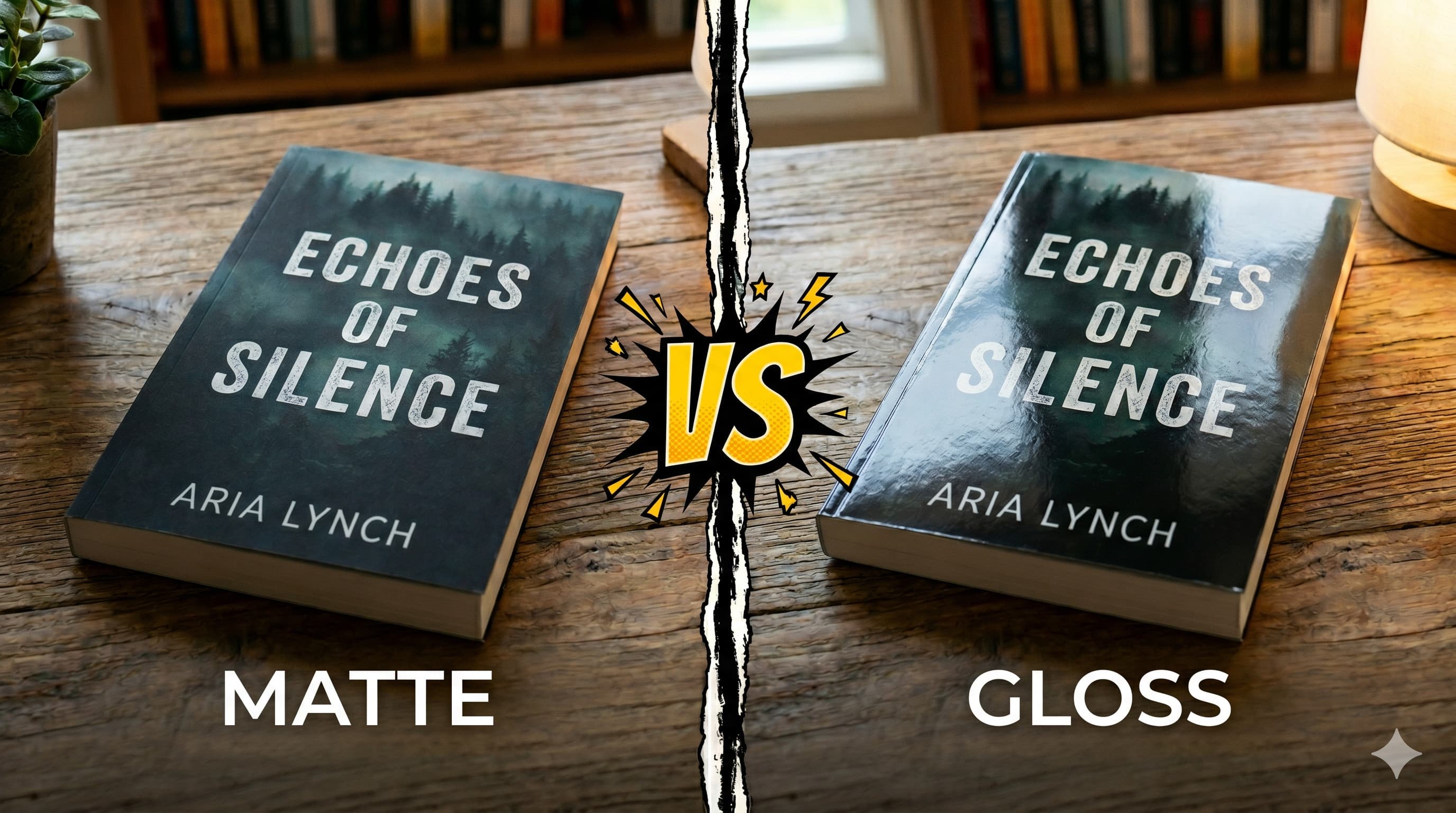
- Matte lamination — non-reflective, soft, slightly velvety
- Soft-touch (silk) lamination — matte's premium cousin, with a noticeably tactile, almost rubbery feel
Most of this post is about the first two, because that's the choice 95% of authors are actually making. We'll come back to soft-touch near the end.
What Gloss Lamination Looks and Feels Like
Gloss is the finish you remember from childhood. It is what most mass-market paperbacks, magazines, and supermarket thrillers wear. Light bounces straight off it. Colours pop. Photographs look saturated and crisp. The cover almost glows under a shop light.
Run your thumb across a gloss cover and it feels slick — almost wet. There is no grain, no resistance. The film is essentially a hard plastic skin over the print.
Gloss tends to suit:
- Commercial fiction — thrillers, romance, mass-market mystery
- Children's books and picture books
- Cookbooks and lifestyle titles with food or product photography
- Coffee-table and photography books where colour saturation matters
- Any cover built around a strong photographic image
- Trade non-fiction aimed at impulse buyers in airports and supermarkets
The shorthand: gloss says "pick me up." It is loud, confident, and wants to be seen from across a shop.
What Matte Lamination Looks and Feels Like
Matte is the modern literary default. It is what most prestige fiction, memoirs, business books, and design-led titles now wear in bookstores. Light hits it and disperses softly instead of reflecting back. Colours look slightly muted compared to gloss — but blacks look deeper, and the cover photographs beautifully without glare.
Run your thumb across a matte cover and it feels soft, almost like fine paper. There is a subtle tooth to it that gloss does not have.
Matte tends to suit:
- Literary fiction and prestige novels
- Memoirs, essays, and biography
- Business, self-help, and serious non-fiction
- Poetry collections
- Academic and reference titles
- Minimalist, type-led cover designs
- Anything where you want the book to feel "considered" rather than "commercial"
The shorthand: matte says "take me seriously." It is quieter, more confident in its restraint, and signals craft.
Side-by-Side: How They Actually Differ
| Factor | Gloss Lamination | Matte Lamination |
|---|---|---|
| Visual impact | High shine, vivid colour, "pops" | Soft, restrained, sophisticated |
| Black depth | Good — but reflections can wash it out | Excellent — deep, inky blacks |
| Photograph rendering | Saturated and crisp | Slightly muted but glare-free |
| Tactile feel | Slick, plastic-smooth | Soft, slight tooth, paper-like |
| Fingerprints | Hides them well | Shows them, especially on dark covers |
| Scratches and scuffs | Hides minor scratches; major ones shine | Shows scratches as lighter marks |
| Light glare | Strong glare under shop and reading lights | No glare — readable from any angle |
| Photograph well | Difficult — reflections fight the camera | Excellent — a designer's preferred surface |
| Price | Identical for most runs | Identical for most runs |
| Genre fit | Commercial, children's, photographic | Literary, business, minimalist, design-led |
Durability: Which One Actually Lasts Longer?
This is the question authors ask most often, and the answer is more interesting than "gloss is tougher."
Gloss is better at hiding minor wear. Small scratches, scuffs from a bag, fingerprints from handling — gloss masks them. The shiny film is uniform, so small marks blend in. Spilled coffee or water beads up and wipes off.
Matte shows wear more honestly. A scratch on a matte cover appears as a thin shiny line, because the scratch has cut through the matte film and exposed the smoother surface beneath. Dark matte covers are particularly unforgiving — fingerprints leave visible smudges, and a single deep scratch is impossible to hide.
But matte's "weakness" is mostly cosmetic and mostly relevant on dark covers. On light or mid-tone matte covers, scuffs are barely visible. And both finishes protect the underlying ink equally well — neither one is going to flake or peel under normal handling.
The honest summary: if your book is going to live in a child's hands, a school bag, a kitchen counter, or a market stall, gloss will look newer for longer. If your book is going to live on a shelf or be handled with the relative care of an adult reader, matte holds up just fine — and many readers find a slightly worn matte book looks more loved than damaged.
The Glare Problem
This is the single argument that has tipped publishing toward matte over the last decade.
Pick up a gloss paperback at a bookstore, hold it under the overhead lights, and watch what happens. Reflections wash across the cover. The title becomes hard to read at certain angles. Photographs of glossy books on social media — the way most readers now discover books — are full of distracting hot spots and shop-light reflections.
Matte solves all of this. There is no glare, no reflection, no hot spot. The cover photographs cleanly from any angle, looks consistent on Instagram and Amazon, and reads clearly under any lighting. For any book that will live online before it lives in someone's hand, this is a real advantage.
Gloss still wins when reflectivity is part of the appeal — children's books that catch light, photography books that need maximum colour pop, cookbooks where food gloss is the point. For everything else, the matte argument keeps winning.
The Fingerprint Problem (And Why It Matters Less Than You Think)
The most common objection to matte is: "But fingerprints show up so badly!"
It's true — and it's mostly only true on dark matte covers. A matte black cover, particularly a smooth flat black, will pick up oil from fingertips and show every smudge. This is why some publishers add a spot UV or soft-touch layer to matte black covers, which we'll cover below.
On light matte covers, mid-tone matte covers, or matte covers with photographic or illustrative artwork, fingerprints are almost invisible. Most readers never notice.
If your cover is heavy on solid dark colour — particularly black, navy, or deep red — and you want matte, plan for one of two upgrades:
- Soft-touch lamination instead of standard matte (hides fingerprints far better)
- Spot UV on the title and key elements (adds shiny accents and gives fingerprints somewhere less obvious to land)
Cost: Is One More Expensive?
For standard runs at our press, gloss and matte are priced the same. The lamination film itself costs about the same; the machine is the same; the labour is identical. Whether you pick matte or gloss, it does not change your quote.
Where cost does change is when you upgrade beyond standard lamination:
- Soft-touch (silk) lamination: roughly 15–25% more than standard matte
- Spot UV on top of matte: adds a separate finishing pass, typically priced per cover
- Foil stamping on top of matte: another finishing pass, priced by area
For most authors, the cost question is simply "matte or gloss" — and the answer is "they cost the same." Choose on aesthetics, not on price.
Soft-Touch (Silk) Lamination: The Premium Option
Soft-touch is matte's more expensive sibling. Visually, it looks like matte — flat, no glare, no shine. But the moment your hand touches it, the difference is obvious. Soft-touch has a velvety, almost rubbery feel that is genuinely pleasant to hold. It is the finish on most premium hardcover jackets and high-end trade paperbacks.
When soft-touch is worth the upgrade:
- Premium fiction or non-fiction where the reader will hold the book for hours
- Gift editions, signed copies, anniversary editions
- Books where the tactile experience is part of the brand
- Dark matte covers where you want to hide fingerprints
When it is not worth it:
- Short-run author copies where the budget is tight
- Books where the cover will mostly be seen on screen
- Pure-text covers without much design weight
If your budget allows it and the genre justifies it, soft-touch is the finish your readers will quietly notice. They may not know what it's called, but they will pick the book up and not want to put it down.
Genre Cheatsheet
If you want a quick cheat by genre, this is roughly how the choice breaks down at our press:
| Genre / Format | Common Choice |
|---|---|
| Literary fiction | Matte or soft-touch |
| Commercial thriller / romance | Gloss |
| Children's picture books | Gloss |
| Memoir / biography | Matte |
| Business / self-help | Matte |
| Cookbook | Gloss |
| Photography / art book | Gloss (or PPC + matte) |
| Poetry | Matte or soft-touch |
| Academic / reference | Matte |
| Spiritual / devotional | Matte |
| Textbook | Gloss (durability wins) |
These are tendencies, not laws. Plenty of literary novels work in gloss, and plenty of thrillers look great in matte. Use the cheatsheet as a starting point, not a rule.
A Decision Framework for the Finish Choice
Once your cover design is final, the finish question usually comes down to four questions:
- What is the dominant element of the cover? Photograph or bright colour → gloss. Type or minimal design → matte.
- Where will the book mostly be seen? Bookstore shelf or kid's hands → gloss. Online and on bookshelves at home → matte.
- What does the genre expect? Look at five recent books in your category. Whatever most of them wear, your reader expects too.
- Is the cover mostly dark? If yes and you want gloss, plan for soft-touch or spot UV — not standard matte.
If you can answer those four, you can almost always make the call confidently.
A Note on Mixing Finishes
One question we get often: can you do matte body with gloss accents (or vice versa)?
Yes. This is spot UV — a clear varnish applied only to specific areas of the cover, on top of matte lamination, to make those areas glossy. The title, the author's name, an icon, a piece of foil-style art — any of these can be spot-UV'd to catch the light against a matte background. The contrast is striking and is one of the most common premium finishes in publishing today.
If you want this look, design your cover with the spot UV areas in mind, and supply us with two files: the printed cover and a separate "spot UV mask" file showing exactly where the varnish should land. Our team can walk you through the file setup if you're not sure.
Get a Sample Before You Commit
Reading about finishes only gets you so far. The fastest way to decide is to hold a matte cover and a gloss cover next to each other, in your hand, in your light.
If you're in Chennai, drop into our office and we'll put printed samples in your hand — matte, gloss, soft-touch, and spot UV — across a few different cover styles, so you can see exactly what your book will feel like before you commit. We do this for authors every week, and the choice usually becomes obvious within thirty seconds of holding them.
If you can't visit, we can post samples to you, or send a quote for both finishes so you can see the numbers side by side.
Send us a quote request with your page count, trim size, copy quantity, and your cover file (or just the design brief), and we'll quote it with your finish of choice.
Have a question first? Email us at info@vstpress.com. We've helped print hundreds of self-published titles and we're happy to talk through the cover finish for your specific book before you commit.